Open site navigation
Explore Comal.News
Send a tip

The Comal Daily

Comal County, before your second cup.

Comal County news every morning, with links to the original sources.

By subscribing, you agree to receive The Comal Daily and to our Terms and Privacy Policy. Unsubscribe anytime.

The Comal Daily

Comal County, before your second cup.

Comal County news every morning, with links to the original sources.

By subscribing, you agree to receive The Comal Daily and to our Terms and Privacy Policy. Unsubscribe anytime.
Send a tip

The Comal Daily

Comal County, before your second cup.

Comal County news every morning, with links to the original sources.

By subscribing, you agree to receive The Comal Daily and to our Terms and Privacy Policy. Unsubscribe anytime.
Comal County, TexasUpdated throughout the day
Local intelligence for a fast-growing county
Send a tip

The Comal Daily

Comal County, before your second cup.

Comal County news every morning, with links to the original sources.

By subscribing, you agree to receive The Comal Daily and to our Terms and Privacy Policy. Unsubscribe anytime.
Comal County news deskLocal reporting, every day

What could New Braunfels road fees mean for a new home?

The modeled one-time road-fee ceiling reaches about $14,622 per new home, before credits or offsets. Council’s next decision will set what new-home projects pay.

Listen to this articleComal.News narrated edition
Ready · 0:00 / 4:40
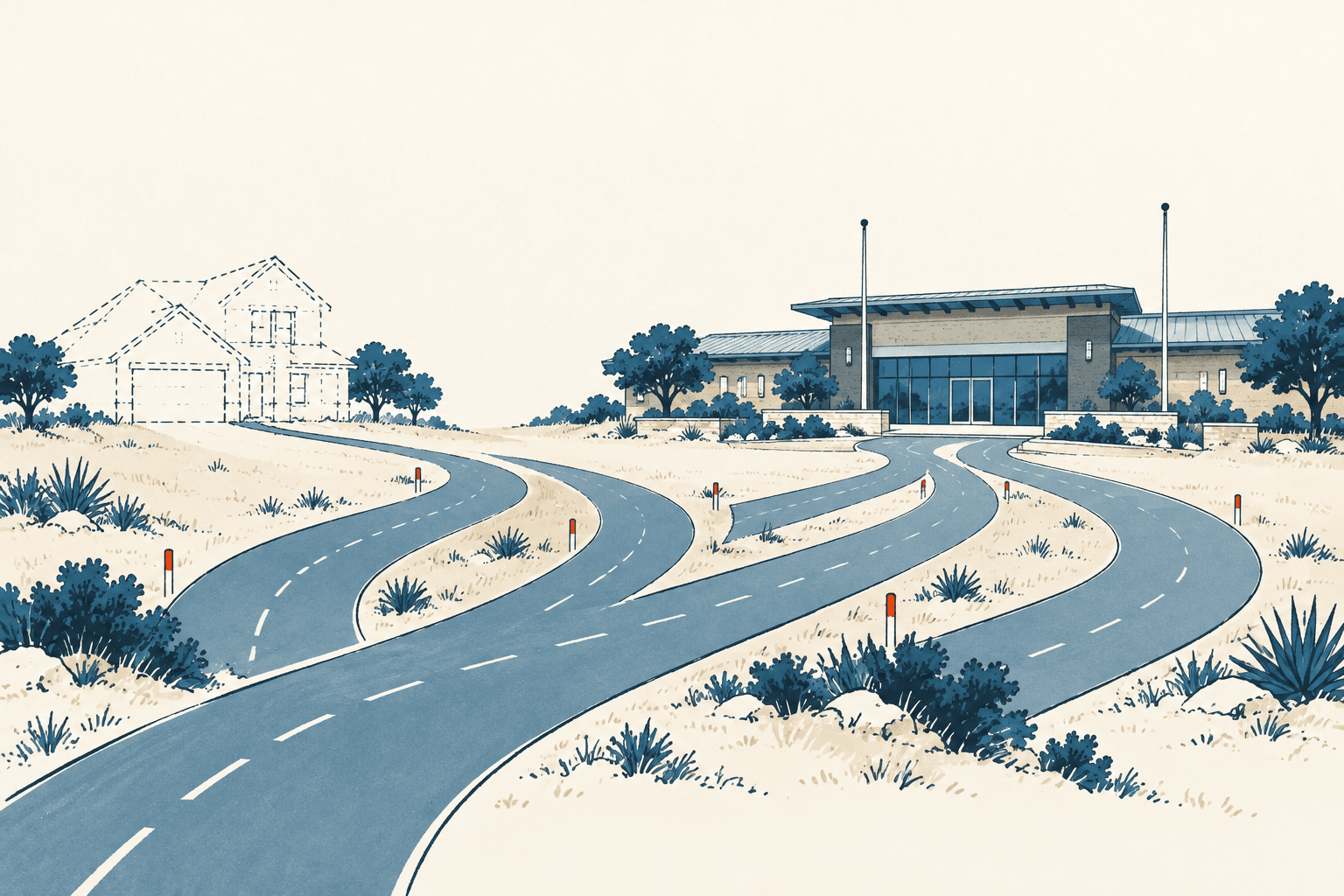
Blue roads curve through pale scrubland toward an outlined house and a modern civic building.
Illustration: Roads branch toward a new home and a civic building, representing roadway fees tied to home construction.Original editorial illustration; not a photograph and does not depict the reported event or an exact property.Comal.News Visual Desk · Original illustration · Source ↗ · Comal.News original illustration ↗

For a modeled new detached home, Comal.News calculates a one-time maximum roadway impact fee of about $5,005 to $14,622 across New Braunfels' six service areas before credits or offsets.

The figures illustrate what the draft study's ceilings could mean for one home. They describe a one-time fee, not an annual or monthly charge or a proposed bill for any particular property. The city's draft study says council chooses the amount to collect at or below those maximums.

What the maximum could cost

The study calculates maximum fees per vehicle-mile of $1,549, $1,590, $1,156, $3,377, $1,550 and $1,828 for service areas 1 through 6, respectively. Comal.News's model applies a 4.33 vehicle-mile assumption to one detached home and rounds the resulting dollar figures in the table. That assumption is recorded in the newsroom calculation; the study page identified as its Table 10 still needs direct verification before treating the model as a property-specific estimate.

Illustrative maximum for one detached home by service area, using 2026 draft study rates and a 4.33 vehicle-mile model
Service areaMaximum per vehicle-mileModeled home maximum
1$1,549$6,707
2$1,590$6,885
3$1,156$5,005
4$3,377$14,622
5$1,550$6,712
6$1,828$7,915

Home figures are rounded from the Comal.News model. They are calculated ceilings before credits or offsets, not adopted collection rates.

The six modeled home maximums are about $6,707, $6,885, $5,005, $14,622, $6,712 and $7,915 for service areas 1 through 6. Area 4's ceiling is nearly three times Area 3's, making the location of a project central to the fee calculation. The table shows the city charge a project could face at the maximum; it does not measure what a builder would add to a sale price.

Who pays and what the money can buy

The draft study says the fee is assessed at final plat and collected at building permit. It limits eligible spending to growth-related road capacity projects in the same service area and excludes existing road deficiencies and maintenance. A higher collected rate would increase what a new-home project pays at the permit stage and the amount available for eligible growth-related road capacity in its service area.

The city's agreed-upon-procedures report says a 2022 ordinance set collected roadway fees at the then-current 2019 maximums, effective March 1, 2023. That history matters because the new study is a recalculation of potential ceilings, while the collected schedule remains a separate council choice. The report describes agreed-upon procedures and expressly does not provide an audit opinion.

What has to go right

Collecting more would shift a larger share of eligible added road-capacity costs to new development in the area receiving that capacity. The public benefit depends on which eligible projects proceed, when they are built and how the final rate and project-specific credits are applied. Existing drivers may gain capacity from those projects, but this fee program does not repair maintenance needs or older deficiencies under the study's rules.

The next decisions

The September committee packet treated fee comparisons and examples for different development types as questions for further work. The official schedule places an advisory recommendation on Oct. 13 ahead of a council hearing on Oct. 26, with a further collected-fee step tentatively set for Nov. 9. Those records establish the next public checkpoints, not the rate council will adopt. Readers can inspect the city's roadway impact-fee materials to compare the final recommendation and any adopted schedule with the modeled ceilings here.

From the source record

Modeled maximum roadway impact fee for one detached home by service area, from the 2026 draft study and a Comal.News calculation.Council may choose a collected rate at or below the calculated maximum.

The Comal Daily

Comal County, before your second cup.

A clear morning briefing, with direct links to the records and sources behind each story.

By subscribing, you agree to receive The Comal Daily and to our Terms and Privacy Policy. Unsubscribe anytime.