
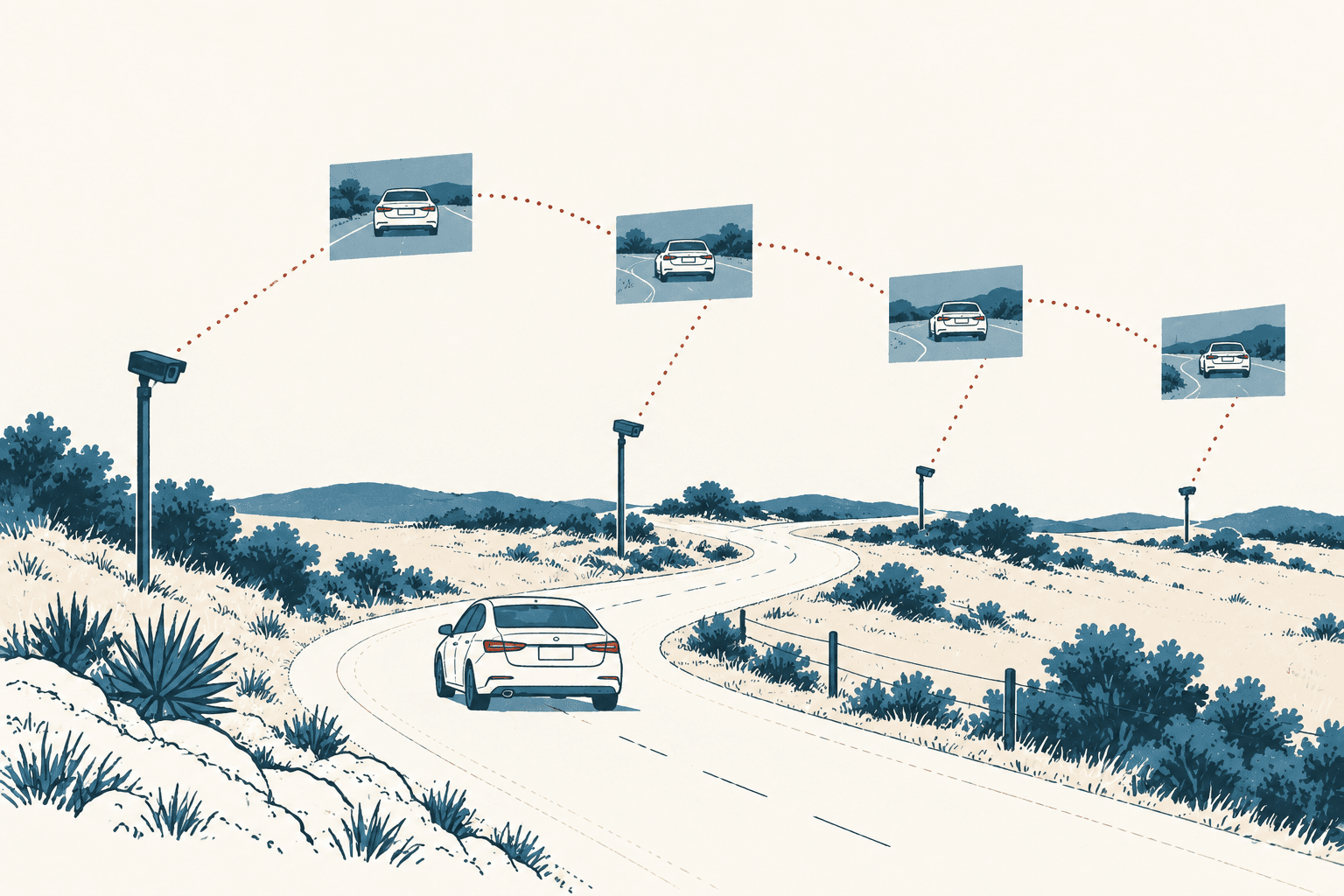
A license plate is public. Where that plate has been for the last 30 days is a different thing.
Flores told council New Braunfels has 57 cameras, 47 working. Some are damaged. A camera can record a plate on a public road; a collection of sightings can let police look back over a driver's route. That difference is where the privacy argument begins.
Flores said the city keeps ALPR data for 30 days unless it becomes part of a criminal case. A driver passing those cameras can leave records that investigators may search during the stated 30-day retention period. That is a practical consequence for people who drive through New Braunfels, even if no officer stops them.
A public road is only the starting point
Police Chief Osvaldo Flores told council the cameras sit on roads “where there is no expectation of privacy.” Taken as a rule for one visible plate, that sounds intuitive. Taken as a rule for every search of an accumulated travel history, it goes too far.
Flores called the presentation “an accountability briefing.” He also acknowledged the constitutional criticism and said the privacy interest “is evolving as long-term aggregation of that data grows.” That second observation gets closer to the hard question: how much can a database reveal when sightings are gathered over time?
In Katz, the Supreme Court said the Fourth Amendment protects people, not places. What someone knowingly exposes to public view gets less protection. But being outside does not end the inquiry by itself. The legal question changes when a passing observation becomes a record of movements.
In Jones, the Supreme Court ruled that attaching a GPS device to a car and using it to track the car was a search because officers physically intruded on the vehicle. Five justices, writing separately, also recognized the privacy problem posed by long-term tracking on public roads. Those opinions raise a concern about accumulated movements; they did not rule that plate readers are searches.